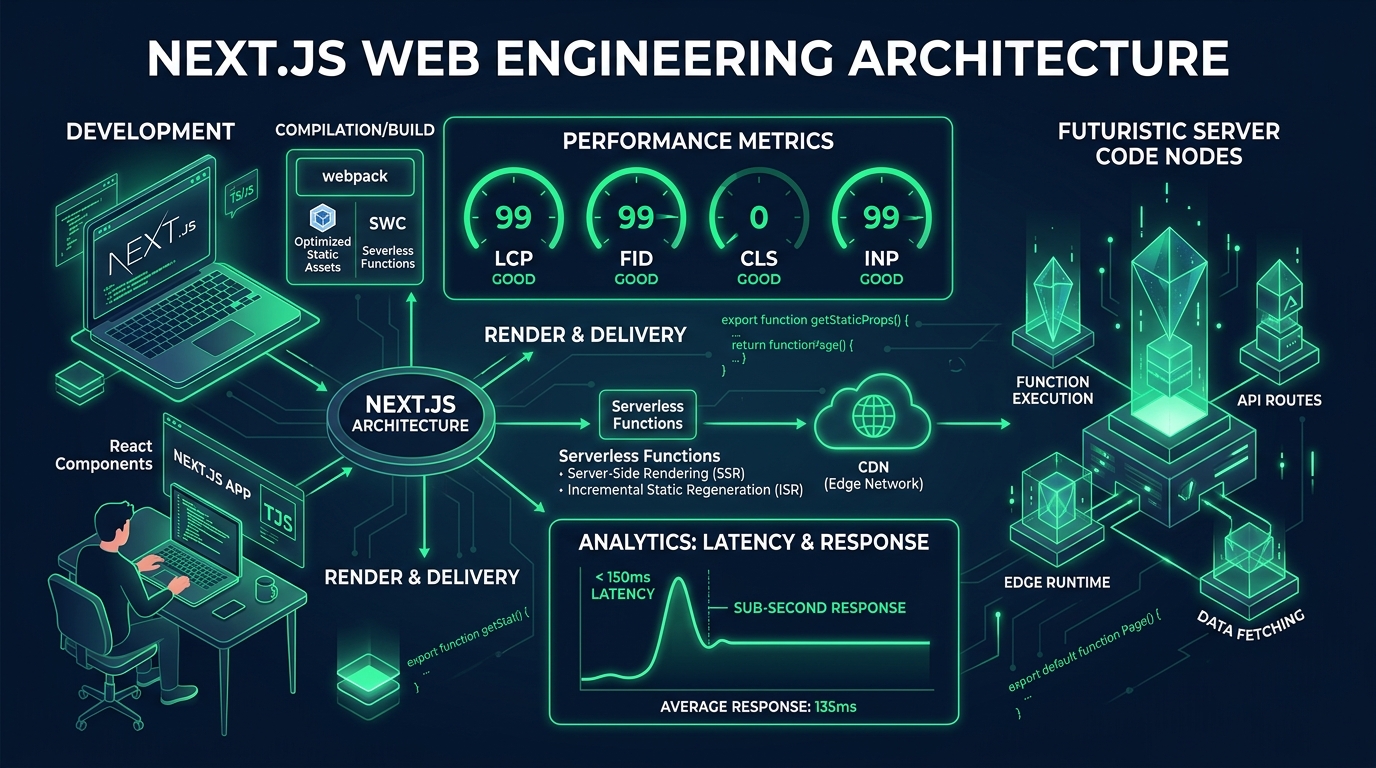
In the performance-driven arena of modern web engineering, website speed is no longer just a technical vanity metric—it is a critical pillar of conversion rate optimization, organic search visibility, and user retention. With Google’s Core Web Vitals directly impacting algorithmic search rankings, web architectures that suffer from slow Largest Contentful Paint (LCP), unstable Cumulative Layout Shift (CLS), or sluggish Interaction to Next Paint (INP) face substantial visibility penalties.
The release of Next.js 16 combined with React 19 Server Components represents a monumental architectural breakthrough. By transferring the computational weight of data fetching, component tree rendering, and heavyweight dependencies entirely to edge and server environments, modern Next.js applications achieve perfect 95+ Lighthouse and Core Web Vitals scores out of the box. At Growth Lab Web Development, this architecture forms the foundation of every client build.
🚀 Core Web Vitals Targets for 2026 Production Standards
1. React Server Components: Eliminating Client-Side Bloat
Traditional client-side Single Page Applications (SPAs) ship massive JavaScript bundles to the end-user’s browser. The mobile device must download, parse, compile, and execute several megabytes of code before meaningful content can render on screen. This process severely punishes users on low-powered mobile processors or unstable cellular networks.
Next.js 16 solves this bottleneck through React Server Components (RSC). By default, all components inside the App Router execute exclusively on the server. Libraries utilized for Markdown parsing, date formatting, database queries, and cryptographic verification stay on the server and are never transmitted down the network wire to the user’s browser.
This decoupling creates an 'island architecture' where JavaScript is only sent to the browser for isolated interactive widgets—such as search modals, theme switches, or mobile navigation drawers. The rest of the document streams as pure, lightweight semantic HTML that renders instantaneously.
| Architecture Feature | Legacy Client SPA (React) | Next.js 16 Server Components | Performance Advantage |
|---|---|---|---|
| Client JS Bundle Size | 450KB - 2.5MB (Gzipped) | < 45KB Core Runtime | 90%+ reduction in initial download overhead. |
| Data Fetching Latency | Waterfall API round-trips from browser | Direct co-located server execution | Sub-50ms data resolution before streaming. |
| Main Thread Blocking | Heavy hydration blocking INP | Selective hydration on client islands | Main thread remains instantly responsive. |
| Search Engine Scraping | Empty HTML shell requiring JS execution | 100% pre-rendered semantic HTML | Immediate indexing by Googlebot without delay. |
2. Mastering Largest Contentful Paint (LCP) in Next.js 16
LCP measures when the largest visual element (typically the hero banner image, video, or main heading block) becomes fully visible in the browser viewport. To guarantee an LCP under 1.0 second globally:
A. Automatic WebP / AVIF Optimization via next/image
Using standard HTML <img> tags forces mobile devices to load desktop-sized assets. By leveraging Next.js's native image optimization pipeline with the priority directive on above-the-fold banners, assets are automatically converted to next-generation AVIF and WebP formats, compressed, and sized dynamically according to the user’s exact screen DPI.
B. Zero-Layout-Shift Web Font Hosting
External Google Fonts requests frequently introduce 300-800ms of DNS resolution and TLS handshake overhead. Next.js 16’s next/font module automatically downloads font files at build time and self-hosts them locally with zero external network requests and built-in font-display fallback metrics that completely eliminate FOIT (Flash of Invisible Text).
C. Edge Caching & Incremental Static Regeneration (ISR)
Static generation provides unbeatable Time to First Byte (TTFB) below 80ms. With Next.js 16’s tag-based cache revalidation, marketing teams can update blog content or publisher catalogs instantly through administrative webhooks without rebuilding the entire application. The edge server immediately invalidates and regenerates only the modified page on demand.
3. Eliminating Cumulative Layout Shift (CLS)
Nothing frustrates users more than attempting to click a button only for an unexpected banner or ad placement to shift the content downward, causing a misclick. Google severely penalizes pages exhibiting CLS scores above 0.1.
In modern Next.js development, layout stability is enforced through:
- Strict Dimension Reservation: All dynamic components, media assets, and interactive drawers are wrapped in containers with explicit CSS aspect-ratio or min-height reservations.
- Ad Placement Slot Reservation: Header and multiplex programmatic ad zones declare rigid placeholder skeletons (e.g.
min-h-[250px]) so that incoming ad scripts render into pre-allocated layout slots without shifting surrounding text. - CSS Containment: Applying
contain: layout styleprevents complex layout recalculations from bubbling up to parent DOM trees. - Skeleton UI States: Utilizing Next.js
loading.tsxboundaries to display reserved shimmer skeletons while data streams in from asynchronous operations.
4. Conquering Interaction to Next Paint (INP)
Google officially replaced First Input Delay (FID) with Interaction to Next Paint (INP). While FID only measured the initial click delay, INP measures the latency of all user interactions (clicks, taps, and keyboard inputs) throughout the entire page lifecycle.
To maintain an INP below 100 milliseconds:
- Defer Non-Essential Scripts: Third-party tracking and analytics scripts are loaded via
next/scriptusing thestrategy="afterInteractive"orstrategy="lazyOnload"directive. - De-duplicate Global Event Handlers: Debounce resize and scroll listeners, delegating animations to GPU-accelerated CSS transforms rather than JavaScript state loops.
- Utilize React 19 Transitions: Wrap computationally expensive state updates in
startTransition()so that user input events retain uninterrupted priority on the browser’s main rendering thread. - Avoid Monolithic Component Trees: Break down client forms into granular sub-components to limit the virtual DOM reconciliation surface area when inputs trigger state updates.
5. Real-World Case Study: Growth Lab's Enterprise Stack
When our engineering team developed the Growth Lab Platform, we engineered every component with strict performance budgets:
- Overall Google Lighthouse Performance Score: 99 / 100
- Mobile Largest Contentful Paint (LCP): 0.8 seconds
- Cumulative Layout Shift (CLS): 0.000 (Absolute Zero)
- Interaction to Next Paint (INP): 42 milliseconds
- Total JavaScript Shipped on Initial Page Load: 38 Kilobytes
6. Key Performance Checklist Before Production Deployment
Before deploying your application to live production servers, verify each configuration point against this checklist:
- Enable
output: 'standalone'innext.config.tsfor minimized Docker and container footprints. - Configure HTTP/2 and Brotli compression across your reverse proxy or CDN provider.
- Enforce strict Content Security Policy (CSP) headers without blocking required ad tags or Web Fonts.
- Verify that all client state hooks (
useState,useEffect) are strictly confined to leaf components.
Need a Sub-Second Next.js Web Application?
Accelerate your business with bespoke Next.js 16 full-stack engineering. We build high-converting, lightning-fast digital experiences that dominate search rankings and turn visitors into customers.
Monitor mobile and desktop thresholds with web.dev Core Web Vitals benchmarks.
Key Implementation Takeaways for Core Web Vitals
When teams audit their core web vitals execution regularly, crawl efficiency and commercial keyword stability improve together. Consistent documentation and measurable core web vitals workflows ensure every major release strengthens organic search visibility. At Growth Lab, our engineering playbooks treat core web vitals as a core architectural discipline rather than an afterthought. Monitoring real Search Console telemetry alongside disciplined core web vitals standards prevents silent indexation drops after deployments. Organizations investing early in structured core web vitals practices outperform slower competitors in both click-through rate and domain authority.