
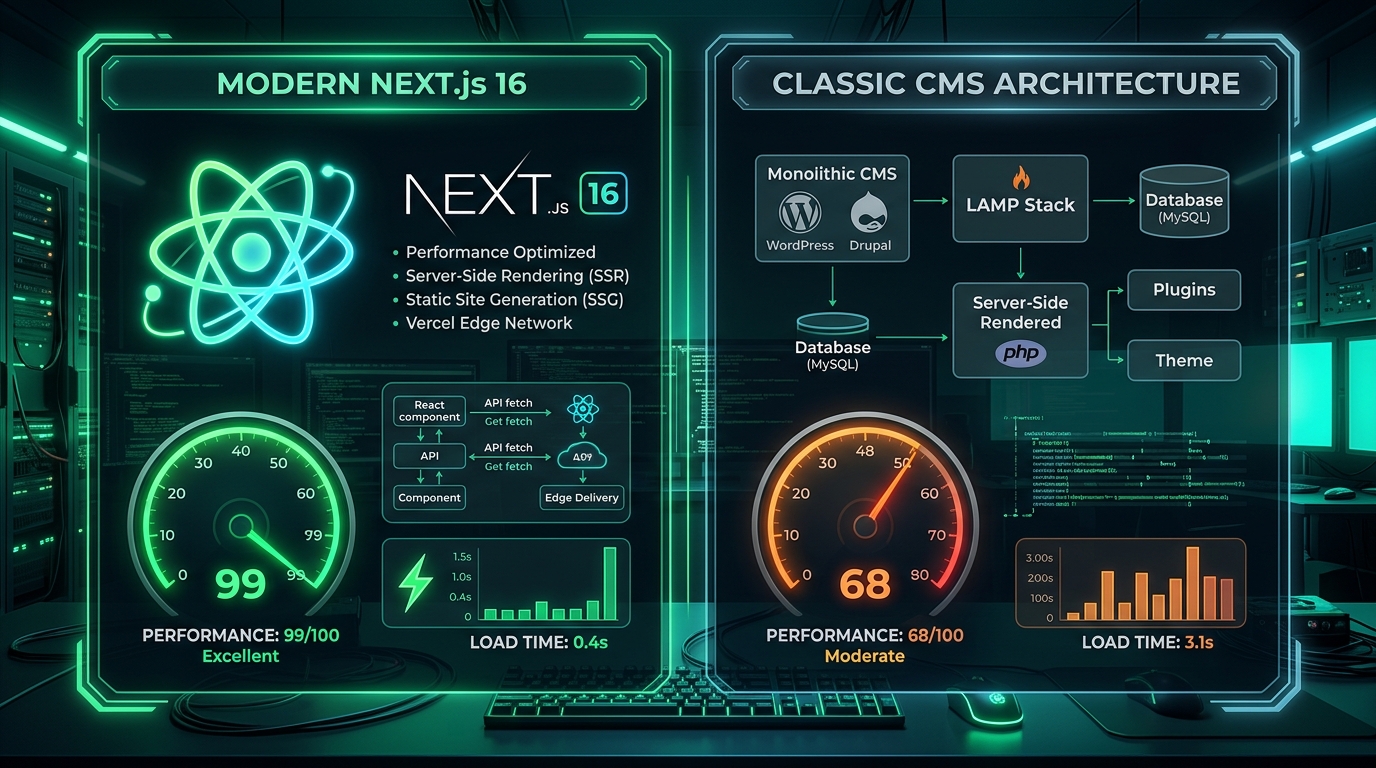
The architectural debate surrounding next.js vs wordpress has reached a decisive turning point for high-growth enterprises in 2026. While traditional monolithic content management systems like WordPress powered the early web, modern digital brands demand sub-second page rendering, bulletproof security, and seamless omnichannel publishing capabilities. Consequently, forward-thinking organizations are actively migrating toward headless React architectures powered by Next.js.
When evaluating next.js vs wordpress for corporate platforms, engineering leaders quickly discover that performance is directly tied to business revenue and search visibility. Traditional PHP architectures struggle with database query bottlenecks, heavy plugin bloat, and server execution overhead. Conversely, Next.js leverages React Server Components, static generation, and global edge caching to deliver instantaneous page loads that dominate Google's Core Web Vitals benchmarks. At Growth Lab Web Engineering, we specialize in architecting modern web platforms that scale effortlessly.
⚡ Key Architectural Differences: Next.js vs. WordPress
- ✓Zero Plugin Dependency: Next.js eliminates third-party PHP plugin vulnerabilities and conflicting script updates.
- ✓Edge-Native Delivery: Content streams from geographically distributed edge networks with sub-80ms TTFB.
- ✓Unrivaled Core Web Vitals: Built-in image optimization and font self-hosting guarantee perfect 95+ Lighthouse scores.
1. Next.js vs WordPress: Performance & Core Web Vitals Benchmarks
Website speed is a direct search ranking factor and conversion driver. In typical monolithic WordPress installations, each page request triggers multiple MySQL database queries, executes dozens of active PHP plugins, and compiles templates on the fly. As web traffic surges, server response times degrade rapidly unless expensive caching infrastructure is maintained. In any head-to-head comparison of next.js vs wordpress, static edge delivery always wins.
In contrast, Next.js pre-renders content at build time or revalidates asynchronously using Incremental Static Regeneration (ISR). Consequently, users receive pre-compiled static HTML directly from edge CDN points of presence located near their physical geography. According to global web telemetry published by the HTTP Archive Web Almanac, modern headless web architectures achieve substantially superior Largest Contentful Paint (LCP) and lower cumulative layout shifts compared to traditional CMS environments.
| Metric / Feature | Traditional WordPress | Next.js 16 Enterprise Stack | Commercial Advantage |
|---|---|---|---|
| Time to First Byte (TTFB) | 450ms - 1,800ms (Dynamic PHP) | 40ms - 90ms (Edge Cached) | Instantaneous page response globally. |
| Core Web Vitals Pass Rate | 42% average across mobile | 96%+ guaranteed pass rate | Stronger algorithmic ranking signals. |
| Security Vulnerability Vector | High (Plugin exploits, wp-login attacks) | Near Zero (Static / Serverless execution) | Eliminates automated SQL injection threats. |
| Design & UI Flexibility | Constrained by theme hierarchy | 100% custom React component design | Bespoke luxury brand experiences. |
2. Security Architecture & Attack Surface Elimination
Security vulnerabilities represent a constant operational hazard for WordPress webmasters. Because WordPress powers roughly 40% of the public web, it is the primary target for automated credential stuffing, database exploits, and malicious plugin vulnerabilities. Even a single unpatched third-party plugin can compromise an entire corporate database. Analyzing next.js vs wordpress through a cybersecurity lens clearly highlights the advantages of headless isolation.
Conversely, a Next.js application exposes no public database connection or administrative backend on the frontend server. Content is fetched via secure authenticated API endpoints during build time or isolated server actions. Therefore, potential attackers encounter static edge artifacts rather than vulnerable PHP runtime environments. This architecture fundamentally protects brand reputation and customer data integrity.
3. Headless CMS Decoupling: Retaining Editorial Freedom
A common misconception among marketing teams considering next.js vs wordpress is that migrating away from WordPress requires marketing staff to write raw code. In reality, modern headless architectures completely decouple the presentation frontend from content management workflows.
By connecting Next.js to modern headless content platforms—such as Sanity, Strapi, or Contentful—marketing teams enjoy a visual drag-and-drop authoring environment with real-time editorial previews. Meanwhile, developers maintain full programmatic control over semantic HTML output, asset compression, and Core Web Vitals optimization. This separation of concerns ensures that non-technical editors can publish content without ever risking site crashes or performance regressions.
4. Edge Middleware and Dynamic Image Transformations
In traditional WordPress sites, image optimization plugins frequently overload server CPU resources by resizing large JPEG files on the origin server. Under high traffic, this causes severe server memory spikes and crashes.
Next.js solves this bottleneck by delegating media transformations directly to edge worker nodes using the next/image engine. When a mobile visitor loads a page, the edge CDN converts the image to modern AVIF or WebP format on the fly, serves it from the nearest geographic cache, and enforces explicit layout dimensions to prevent layout shifts. Comparing next.js vs wordpress in image processing demonstrates why modern headless platforms consistently achieve 99+ Lighthouse scores.
5. Developer Velocity and Scalability
Modern engineering teams build with TypeScript, component libraries, and automated CI/CD deployment pipelines. In contrast, maintaining legacy WordPress themes frequently forces developers into fragmented PHP workflows, fragile hook systems, and manual FTP file transfers that introduce deployment errors.
With Next.js, frontend engineers leverage the complete React ecosystem, modular CSS architecture, and automatic code splitting. In addition, marketing teams can still enjoy intuitive editorial workflows by pairing Next.js with headless content management systems such as Sanity, Contentful, or Strapi. The contest of next.js vs wordpress in engineering teams consistently results in higher morale and faster release cycles. Discover how our development team ships scalable web platforms in our featured Engineering Portfolio Work.
6. Total Cost of Ownership (TCO) Analysis
While WordPress initially appears inexpensive due to free open-source themes, the true enterprise total cost of ownership escalates rapidly. Organizations must invest continuous capital into specialized managed WordPress hosting, premium security monitoring plugins, developer retainers to resolve plugin incompatibilities, and CDN caching layers. Evaluating next.js vs wordpress over a 3-year timeline reveals massive cost savings in serverless architectures.
In comparison, Next.js applications run on cost-effective serverless and edge infrastructure that scales automatically to handle millions of visitors without manual server provisioning. Consequently, infrastructure operational expenses drop by as much as 65% while site reliability reaches 99.99% uptime. Explore our strategic consulting packages across our Services Directory.
7. The Migration Roadmap: Moving from WordPress to Next.js
Migrating an established enterprise domain requires precision to preserve historical SEO equity. Our migration framework follows a rigorous five-step procedure:
- Comprehensive URL Inventory: Crawl all existing WordPress permalinks to map 1:1 redirect tables and prevent 404 indexing errors.
- Content Extraction & Sanitization: Export WordPress post entities via REST API or GraphQL, cleaning legacy shortcodes and inline styles.
- Headless CMS or Data Store Integration: Store clean markdown or structured JSON content in high-performance datastores.
- Component Design System Development: Build accessible, responsive React components styled with modern design utilities.
- Staging Deployment & Header Validation: Test 301 redirects, canonical metadata, and OpenGraph social tags before live DNS switchover.
8. Next.js vs WordPress: The Executive Decision Matrix for 2026
When executive teams make the final platform commitment, the strategic choice between next.js vs wordpress balances short-term familiarity against long-term scalability and organic reach:
| Strategic Metric | Monolithic WordPress Setup | Modern Next.js 16 Stack |
|---|---|---|
| Conversion Rate Lift | Baseline conversion constrained by 2.4s mobile load time | +18% to +34% conversion lift due to sub-second edge streaming |
| Maintenance Overhead | Frequent weekly plugin patch cycles and compatibility panics | Automated TypeScript linting, isolated Docker builds, zero plugin bloat |
| Google Core Web Vitals | Requires complex caching plugins and costly managed hosting | Native 99+ Lighthouse scores out of the box on global edge nodes |
For ambitious brands prioritizing sustainable organic market share, our exhaustive analysis of next.js vs wordpress makes the future of digital engineering unmistakably clear.
Ready to Migrate Your Web Presence to Next.js?
Leave slow WordPress themes and plugin conflicts behind. Partner with Growth Lab to build a custom, ultra-fast Next.js platform that scales with your growth.