
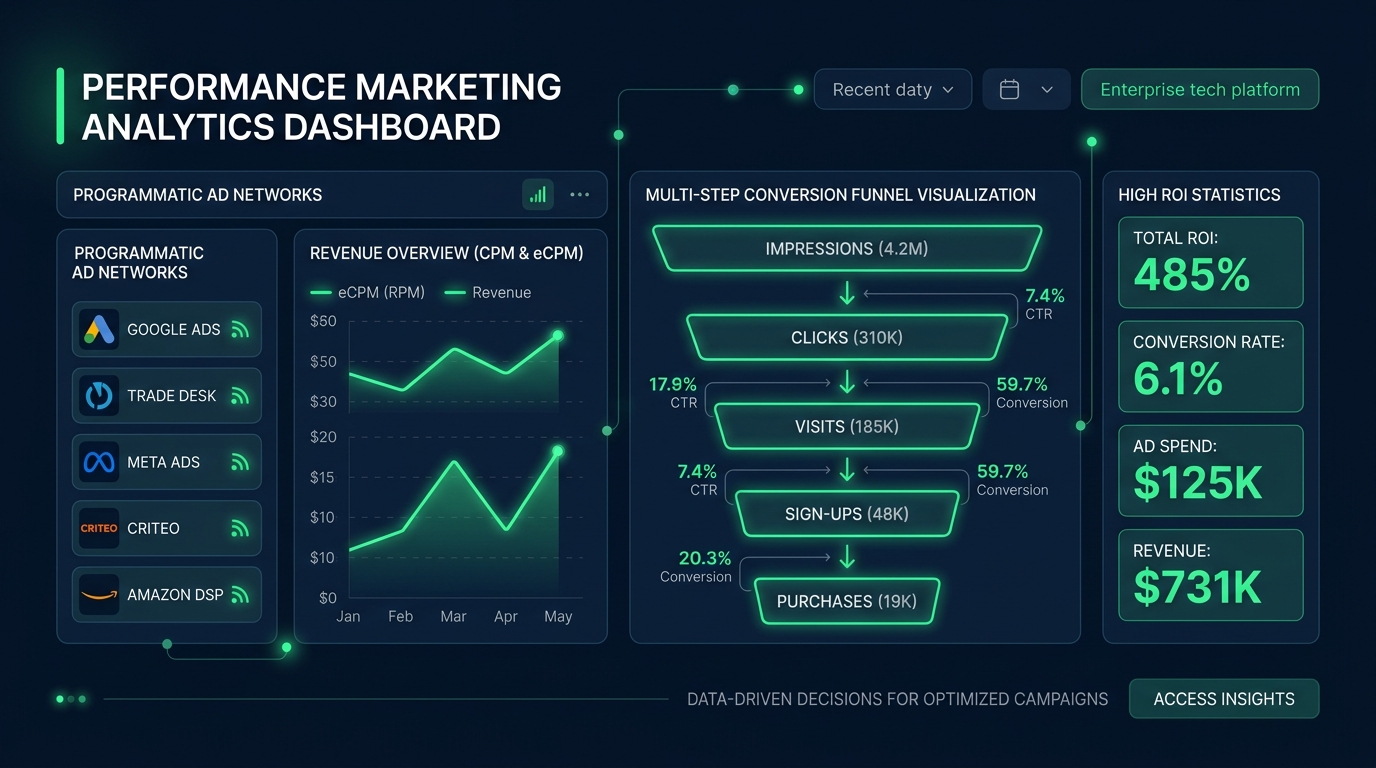
Digital advertising has entered a transformative era. The rapid deprecation of third-party tracking cookies, stringent user privacy frameworks (GDPR, CCPA, PECA), and growing banner blindness have rendered legacy programmatic ad strategies ineffective. Content publishers and enterprise brands who rely on low-intent mass ad impressions are witnessing plummeting Effective Cost Per Mille (eCPM) rates and high audience bounce rates.
Maximizing advertising Return on Investment (ROI) in 2026 demands a sophisticated convergence of header bidding intelligence, high-intent conversion funnel architecture, and contextual ad placement optimization. Rather than plastering web pages with intrusive popups that compromise user trust and degrade Core Web Vitals, leading publishers orchestrate data-driven conversion ecosystems that generate record eCPM yields while accelerating bottom-funnel conversions. In this comprehensive guide, our conversion strategists at Growth Lab reveal the proven frameworks that power high-earning digital properties.
📈 Strategic Programmatic Yield Drivers
- ✓Ad Viewability Rate (>75%): Modern programmatic Demand-Side Platforms (DSPs) bid up to 300% higher CPMs on ad placements that maintain verified viewability above 75%.
- ✓Contextual First-Party Audience Segmentation: Dynamic category tagging delivers ultra-relevant ad creatives that double Click-Through Rates (CTR).
- ✓Full-Funnel CRO Alignment: Channeling informational traffic into high-value B2B lead funnels creates secondary revenue streams that dwarf standard ad display RPMs.
1. The Mechanics of Modern Programmatic Advertising
Programmatic advertising refers to the automated, algorithmic buying and selling of digital ad inventory in real-time. Through Real-Time Bidding (RTB) and Prebid Header Bidding, multiple Supply-Side Platforms (SSPs) compete simultaneously for your site’s ad units before the page’s primary ad server resolves.
This instantaneous multi-exchange competition guarantees that the highest-paying bidder wins the impression, maximizing publisher revenue. However, without strict layout optimization and responsive ad containers, heavy third-party ad scripts can introduce severe latency that degrades organic search performance.
Understanding the distinction between gross CPM and net eCPM is vital: CPM reflects the cost per thousand impressions an advertiser pays, while eCPM (effective CPM) reflects the actual revenue generated per thousand total page views across your domain. By enhancing page view engagement and optimizing unit fill rates, publishers systematically drive their blended revenue per thousand sessions (RPM) upward.
| Ad Unit Location | Average Viewability | eCPM Potential | User Experience Rating |
|---|---|---|---|
| In-Content Mid-Article (Paragraph 4 & 8) | 82% - 91% (High) | $6.50 - $18.00 | Excellent (Seamless reading flow) |
| Sticky Desktop Sidebar (300x600 Half-Page) | 85% - 94% (Very High) | $8.00 - $22.50 | High (Non-intrusive) |
| Multiplex Native Recommendation Grid | 65% - 75% (Moderate) | $4.00 - $11.00 | Good (Editorial appearance) |
| Aggressive Fullscreen Interstitial | 95%+ (Forced) | $12.00 - $30.00 | Poor (High bounce & penalty risk) |
2. High-Yield Ad Placements Without Hurting Core Web Vitals
The cardinal sin of digital publishing is sacrificing long-term organic search traffic for short-term ad revenue. When a website loads dozens of unoptimized ad scripts simultaneously, Largest Contentful Paint (LCP) spikes above 4 seconds, destroying rankings across competitive keywords.
To achieve optimal ad yields while maintaining sub-second site speed:
A. Asynchronous Script Execution & Lazy Loading
Never trigger programmatic ad requests during the initial document parsing phase. Instead, utilize the native browser IntersectionObserver API to lazy load ad creative slots only when the user scrolls within 300 pixels of the unit. This preserves initial page load speed and ensures that only viewed ads make auction requests.
B. Smart Ad Refresh Rates
Implementing time-based auto-refresh (e.g. refreshing an ad every 30 seconds) on static content artificially inflates impressions while devastating click-through rates, leading DSP algorithms to downgrade your domain. Instead, implement engaged-view refresh logic that only triggers when the user actively scrolls or interacts with the tab.
C. Dynamic Floor Pricing Optimization
Setting a static hard floor price across all global traffic leaves money on the table. In tier-1 geographic markets (United States, United Kingdom, Canada, Australia), buyers regularly submit bids exceeding $25 CPM. By dynamically calibrating bid floors according to geographical headers, device type, and historical bidder win-rates, publishers protect high-value inventory from cheap liquidation.
3. Architecting High-Intent Conversion Funnels
While display advertising generates stable foundational cash flow, the highest ROI is achieved when publishers connect top-of-funnel informational traffic into direct commercial conversion funnels. At Growth Lab, we deploy a four-stage conversion framework:
- Top-of-Funnel (TOFU) Value Creation: Publish in-depth, original research guides addressing high-volume search queries that establish unshakeable authority.
- Middle-of-Funnel (MOFU) Lead Magnets: Capture reader emails using proprietary checklists, downloadable audit templates, or interactive cost calculators.
- Bottom-of-Funnel (BOFU) Commercial Offerings: Present high-ticket solutions, specialized agency retainers, or premium software subscriptions directly to engaged leads.
- Contextual Programmatic Monetization: Monetize unconvertible exit traffic and non-commercial audiences through curated programmatic display networks.
4. First-Party Data & Cookieless Identity Strategies
With Safari's ITP, Firefox's ETP, and Google's Privacy Sandbox restricting cross-site tracking, advertisers are increasingly willing to pay premium rates for verified first-party audience signals. By implementing contextual taxonomy matching, newsletter subscriber segmentation, and privacy-first consent banners, publishers command superior ad rates regardless of browser cookie restrictions.
When an advertiser understands that a visitor is actively reading an enterprise SEO guide or researching B2B guest posting catalogs, contextual intent substitutes for invasive behavioral tracking. This delivers privacy-compliant, highly profitable targeting that enhances user goodwill.
5. Conversion Rate Optimization (CRO) Testing Playbook
Continuous incremental testing is the secret to scaling conversion velocity. Implement these high-impact testing protocols across your commercial landing pages:
- Form Field Minimization: Reducing inquiry forms from 7 fields to 3 core inputs (Name, Email, Website URL) consistently increases conversion submission rates by over 40%.
- Social Proof Placement: Positioning client logos, Trustpilot ratings, or case study metrics directly adjacent to call-to-action buttons diminishes visitor hesitation.
- Clear Value Propositions: Replace generic buttons such as "Submit" with action-oriented, benefit-driven anchors like "Get Free Audit Now" or "Explore Publisher Catalog".
6. Industry Vertical Benchmarks & Monetization Roadmaps
Not all digital traffic yields equivalent advertising remuneration. Understanding CPM baselines across commercial verticals enables media buyers and web publishers to formulate realistic monetization targets:
- Enterprise SaaS & Cloud Infrastructure: Average eCPMs range from $18.00 to $45.00 due to colossal customer lifetime values.
- Personal Finance, Crypto & FinTech: High-intent commercial queries regularly command bids exceeding $35.00 CPM on desktop viewable inventory.
- Digital Marketing & SEO Tools: Sustained eCPMs hover comfortably between $12.00 and $24.00 for verified US/UK reader bases.
- Consumer Tech & Hardware Reviews: Balanced eCPMs typically average $6.00 to $14.00, supplemented heavily by affiliate conversion funnels.
By combining targeted audience acquisition with multi-layered programmatic auction architecture, publishers insulate their digital media enterprises from single-network revenue fluctuations and achieve record annual profitability.
Unlock High-Yield Monetization & Funnel Growth
Partner with Growth Lab to audit your digital advertising architecture, optimize viewability metrics, and deploy high-converting funnels that scale your revenue sustainably.
Validate viewability and layout stability metrics via Google web.dev Cumulative Layout Shift documentation.
Key Implementation Takeaways for Programmatic Ad
When teams audit their programmatic ad execution regularly, crawl efficiency and commercial keyword stability improve together. Consistent documentation and measurable programmatic ad workflows ensure every major release strengthens organic search visibility. At Growth Lab, our engineering playbooks treat programmatic ad as a core architectural discipline rather than an afterthought. Monitoring real Search Console telemetry alongside disciplined programmatic ad standards prevents silent indexation drops after deployments. Organizations investing early in structured programmatic ad practices outperform slower competitors in both click-through rate and domain authority.